
The Heads & Hearts Model
Providing clarity, structure & purpose for those attending & facilitating reflective practice groups

Reflective practice groups are in high demand as a way of improving practice, supporting staff wellbeing and developing compassionate cultures of care. Set-up and facilitation of groups require training and ongoing supervision which are not routinely available, and there is often confusion regarding the aims of reflective practice and how to approach the facilitation task.
The Heads and Hearts model was developed to address this. It is a comprehensive, evidence-based approach, providing structure, clarity and purpose to facilitators and those commissioning and participating in reflective practice groups. The dual aims of the model are whole-person learning and peer connection. Please see below for selected endorsements from Arabella Kurtz’s book describing the model, published by Routledge in 2020 (a second edition is coming out in April 2026).
Training in the Heads and Hearts model is available for those wanting to actively develop the provision of reflective practice in their services and organisations. The training consists of a two-day training by a year of supervised practice and is usually delivered to small groups, allowing plenty of opportunity for discussion.
We offer a full accreditation training in the Heads and Hearts model for those wanting to develop provision of reflective practice groups in their service or organisation.
Reflective practice groups are in high demand as a way of improving practice, supporting staff wellbeing and developing compassionate workplace cultures. Set-up and facilitation require training and supervision which are often not available, and there is sometimes confusion about the aims of reflective practice groups and how to run them successfully.
The Heads and Hearts model is comprehensive and evidence-based; it is fully described in Arabella Kurtz’s book ‘How to Run Reflective Practice Groups’, a second edition of which is coming out in April 2026. The model offers clarity, structure and purpose to facilitators and those commissioning and participating in groups. The dual aims of the model are whole-person learning about practice and peer connection.
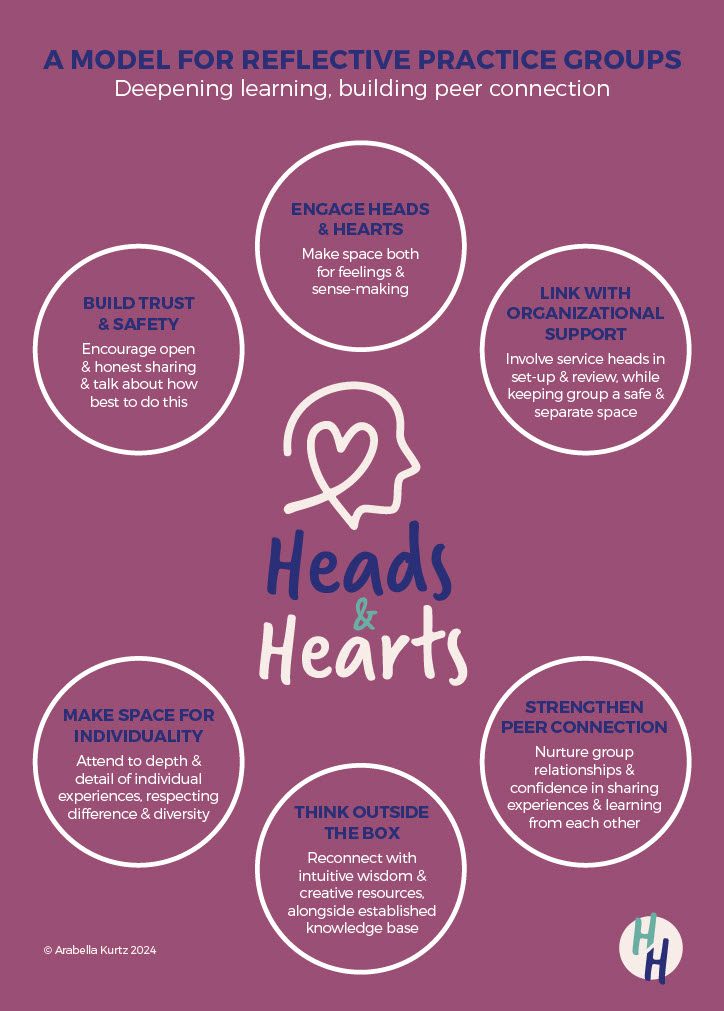
Whole-person learning and peer connection
Engage Heads & Hearts: Make space for both feelings & sense-making
Make space for individuality: Attend to depth & detail of individual experiences & respect difference
Think outside the box: reconnect with intuitive wisdom & creative resources
Build trust and safety: encourage open & honest sharing
Strengthen peer connection: nurture group relationships and confidence
Make space for individuality: attend to depth & detail of individual experiences
Link with organizational support: involve service heads while keeping the safe space
Get the Reflective Practice Book
Arabella Kurtz has written a guide for healthcare professionals on how to run reflective practice groups. This is a great addition to your library with practical tips on introducing successful and effective reflective practice groups in your teams and organisation.
Available from a range of book stores.
Arabella Kurtz Introduces the Heads & Hearts Model
In this Video Blog, Arabella Kurtz provides a brief introduction to the Heads and Hearts model of reflective practice groups.
Accreditation in the Heads & Hearts Model
This one-year training is delivered by Arabella Kurtz, who developed the Heads and Hearts model, and a small group of colleagues with many years’ experience of running reflective practice groups. It starts with a two-day in person training in the what and the how of facilitating Heads and Hearts groups, followed by a year of supported practice. Training participants join small peer supervision groups, reconnect with trainers at fixed points across the year, and are each observed running a reflective practice group.
Please see below for endorsements from colleagues who have done the training and get in touch if you are considering this for yourself or your organisation
Endorsements for training in the Heads & Hearts model

"The Heads & Hearts model was really well explained. The section on group dynamics was so interesting and Arabella was able to explain complex concepts so accessibly."
"Thank you for the fabulous training and wraparound support and guidance!"
"I really liked how we could locate the framework within practice and seeing how this model aligns to what I'm already doing. It was helpful to hear about the evidence base and research too."
Endorsements for the 1st edition of ‘How to Run Reflective Practice Groups: A Guide for Healthcare Professionals'
“Dr Kurtz brings her wealth of clinical expertise and experience to this excellent new book. While it is an eminently practical manual, grounded within NHS culture and steeped in clinical practice, it is also clearly underpinned by the relevant theoretical influences and empirical research. This makes it an important new addition to the field of Reflective Practice, which is long overdue. I wish it had been available to me!”
Delia Cushway
Emeritus Professor of Clinical Psychology
Coventry University, UK
“Arabella Kurtz makes a compelling case for the place of reflective practice in healthcare settings and in the training of healthcare professionals. She has drawn on her considerable experience as well as theory to produce a clear Intersubjective Model for reflective practice. Each stage of the model is described in separate chapters which provide excellent guidance and examples of what to do as a facilitator. The first stage deals uniquely with the organisational and contractual issues that so often interfere with the establishment and effective running of reflective groups. The remaining stages guide the reader through the essential tasks of reflective groups. If services are to develop a culture of compassionate care then reflective practice should be integral and this book provides a model for how this could be achieved.”
Tony Lavender
Emeritus Professor of Clinical Psychology
Canterbury Christ Church University, UK
“Reflective practice is increasingly proffered as a panacea to the pressures on healthcare staff of rising clinical demand, financial austerity and a target driven culture, yet it is poorly defined and often difficult to implement. Based on years of working with the lived experience of practitioners in an extensive range of settings, Kurtz has developed a unique, yet widely applicable, intersubjective model of reflective practice integrating experiential, psychoanalytic, and phenomenological approaches. By allowing a space for intuition, emotional responsiveness and creativity to develop, staff groups are facilitated in deepening their understanding of human relationships and finding meaning in their work. This book offers an accessible, practical and much-needed guide to reflective practice which will be relevant to all disciplines working in health and social care services.”
Jessica Yakeley
Consultant Psychiatrist in Forensic Psychotherapy
and Director of the Portman Clinic, Tavistock and Portman NHS Foundation Trust, UK